Andrew Todd Marcus
Case Study — Systems Design for Learning

From One Student's Transcript to a Global Learning Platform

When NuVu Studio's first full-time student needed a college transcript, no existing format could represent what she had actually done — iterative, interdisciplinary, project-based work that didn't map to courses, grades, or credit hours. The solution I designed for her became the seed for the Studio Management System: a platform that unified curriculum, assessment, documentation, and portfolio into a single ecosystem, eventually serving 7,000+ students across 15 partner schools in seven countries.

This is the story of how a handmade document for one student grew into institutional infrastructure — through iterative design, deep collaboration, and a refusal to flatten complex learning into simple metrics.

Systems Design Assessment Architecture Platform Design Organizational Infrastructure 7 Countries 7,000+ Students
The Design Problem
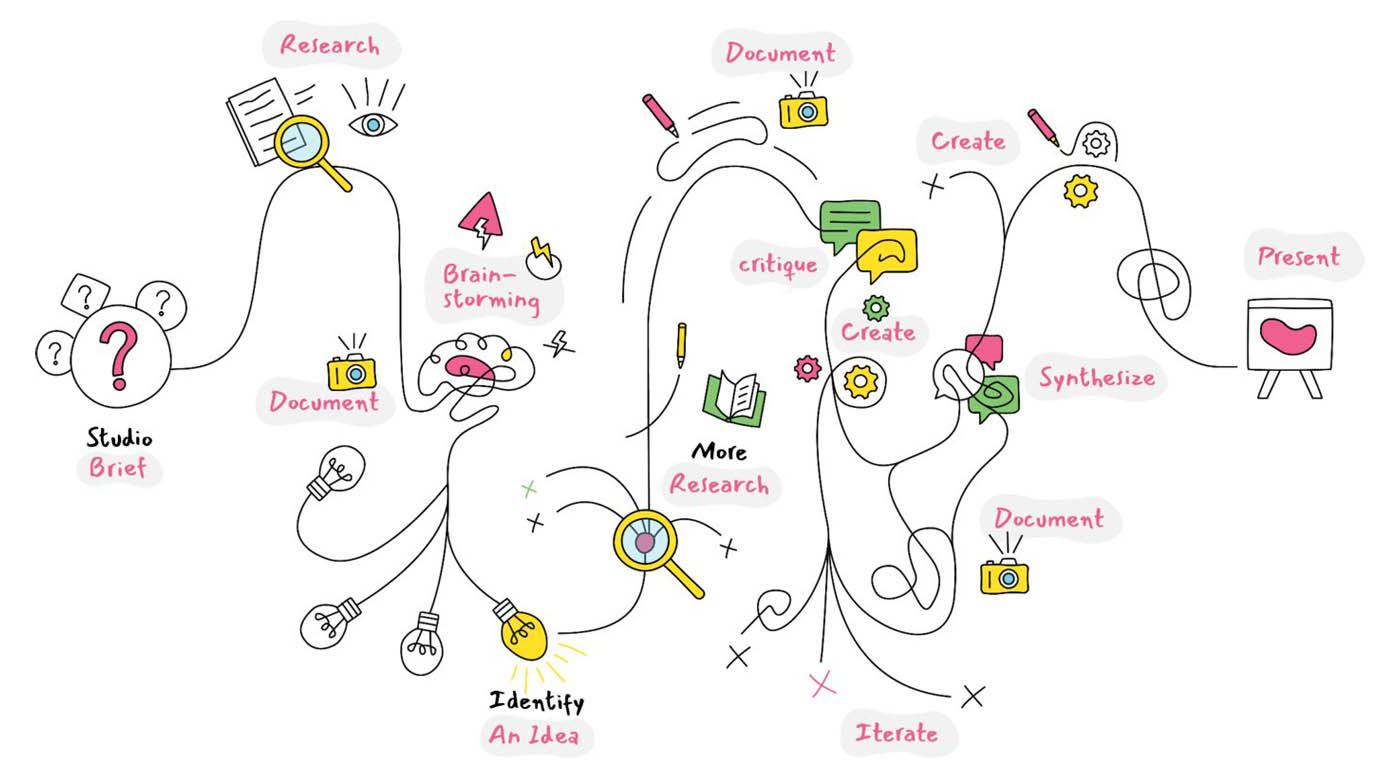
NuVu's iterative design process — from studio brief through research, brainstorming, iteration, critique, and presentation
NuVu's design process — the pedagogy the platform had to embody, not just describe.
The Representation Gap
Students at NuVu worked across disciplines — architecture, engineering, film, data science — in collaborative studios that produced real artifacts. Traditional transcripts (courses, grades, credit hours) couldn't represent this. The gap wasn't cosmetic; it was structural.
The Dual Mandate
The system had to face two directions simultaneously: outward toward colleges and employers who needed legibility and rigor, and inward toward students and faculty who needed a tool for reflection, feedback, and growth. Most assessment systems choose one. This one had to do both.
Process Over Product
NuVu's pedagogy valued iteration, documentation, and critique as much as final outcomes. The assessment system couldn't just record results — it had to make the creative process visible, valued, and evaluable.
Jump to platform development the system assessment impact exhibits
The Platform in Action

A digital sketchbook, learning management system, and portfolio tool

The Studio Management System acts as a virtual studio space — where coaches communicate intent and resources, students document their process through sketches, photographs, design research, and writing, and the entire community participates in feedback and critique. Built-in collaborative assessment tools allow students and coaches to formally evaluate progress and record success through portfolios, transcripts, and written narrative evaluation.

NuVu Studio platform demo
Watch on YouTube →
Platform demo — documentation, collaboration, assessment, and portfolio in a unified system.
Iterative Development

Four prototypes over six years

The system wasn't designed all at once. Each iteration responded to real needs, real failures, and real feedback from students, families, faculty, and admissions officers. The design process mirrored NuVu's own pedagogy: iterative, feedback-driven, and deeply collaborative.

Prototype 1 — Handmade Transcript

One student, one document, proof of concept

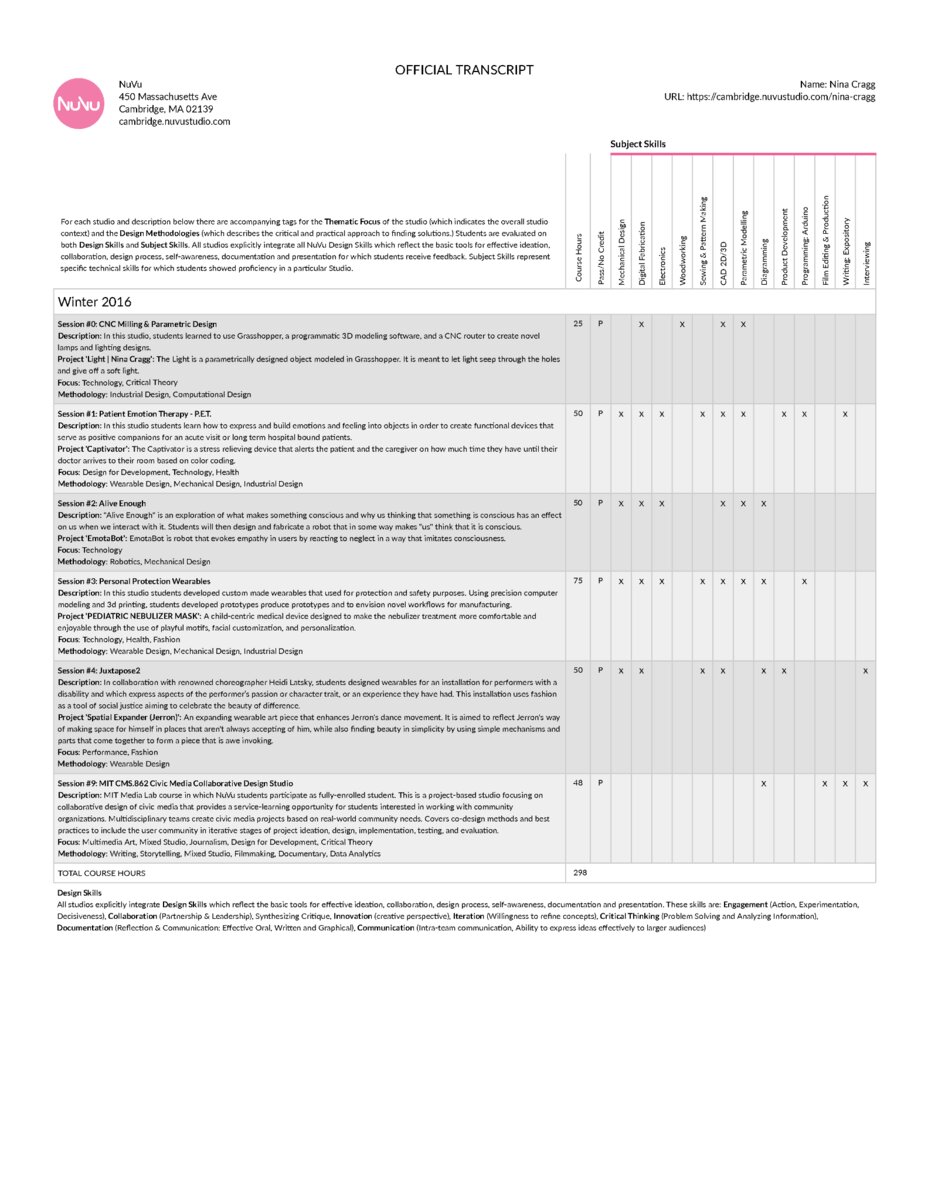
The first prototype was crafted entirely by hand for NuVu's first full-time student, whose college aspirations required a transcript that was both credible and true to the work. Narratives, projects, and skills were mapped manually — weaving together process documentation, portfolio artifacts, and evidence of growth. Drawing on competency-based models, this transcript reverse-engineered assessment frameworks to reflect NuVu's pedagogy while meeting the expectations of admissions officers.
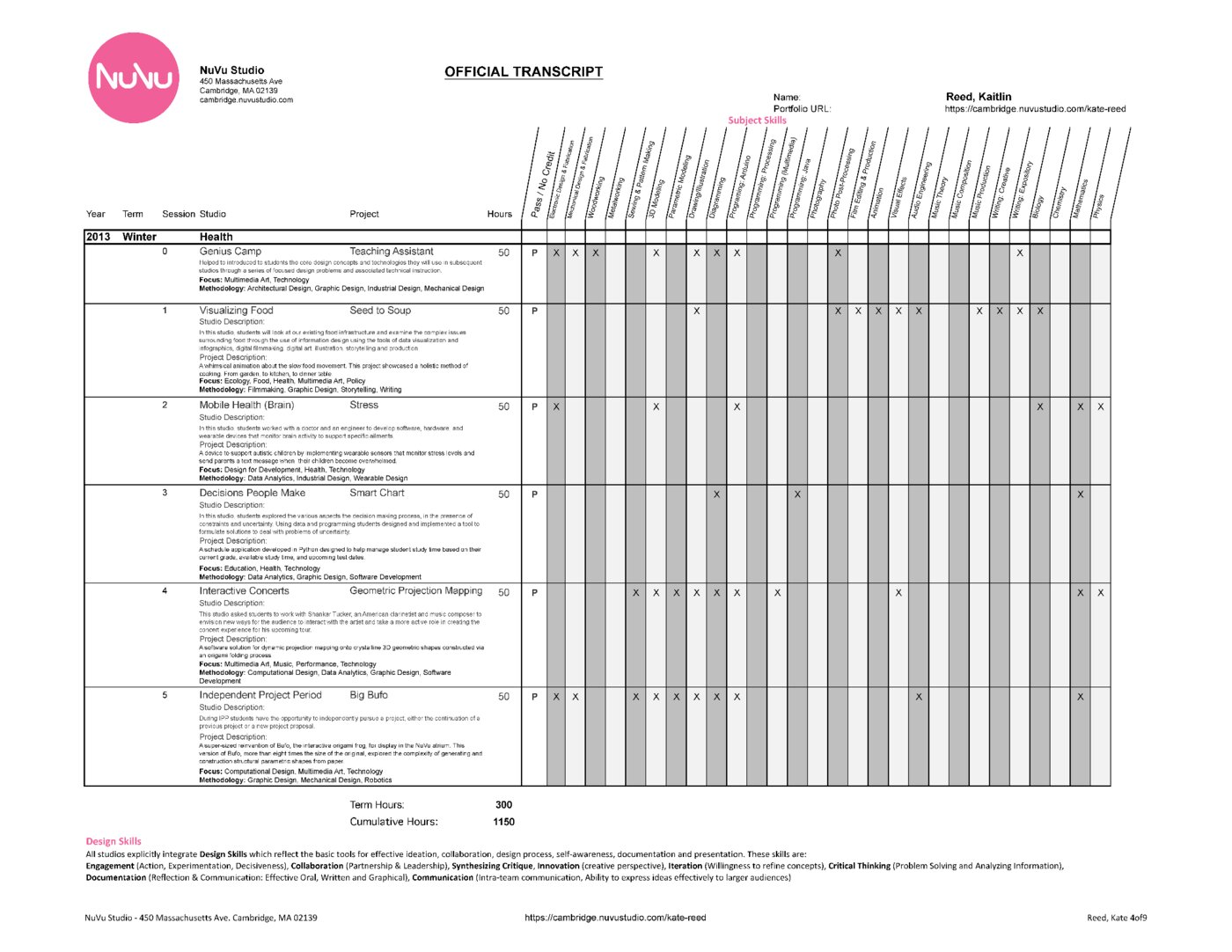
NuVu Official Transcript — handmade version with full skills matrix
The handmade transcript — skills matrix, studio descriptions, project documentation, and narrative evaluation on a single document.

Impact: The student was admitted to a dual degree program at Brown + RISD — validating the transcript as a bridge between innovative pedagogy and institutional credibility.

Prototype 2 — LMS Integration

Embedded in the platform, generated per-student

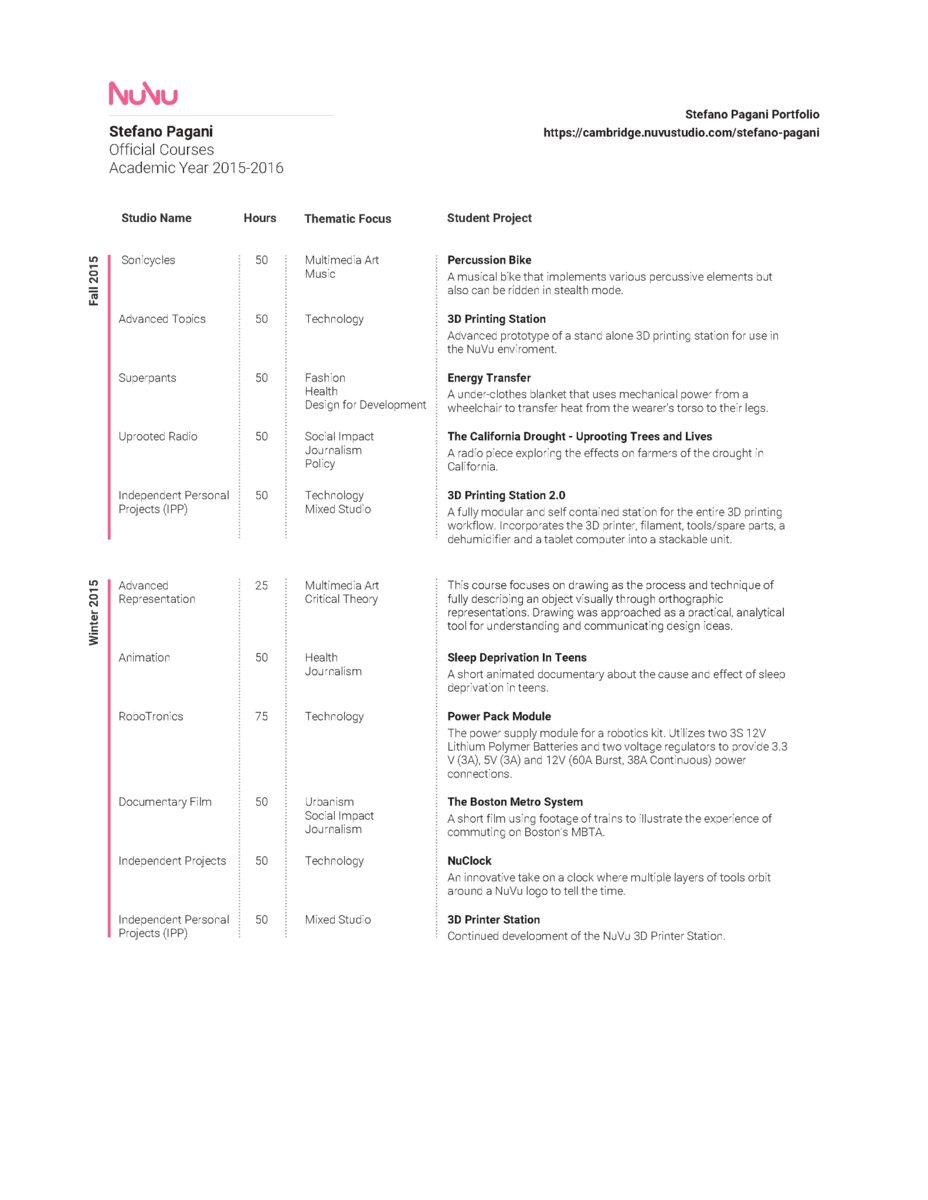
Early transcripts were embedded into the backend of the developing Studio Management System, enabling per-student generation. Rapid development cycles allowed workflow testing, faculty training, and the first integration of pedagogy and assessment as core platform functions. Progress reporting for families and the broader school community began here.

LMS-integrated transcript version
Transcript companion view
Per-student transcript generation — still evolving the skills framework and narrative structure.
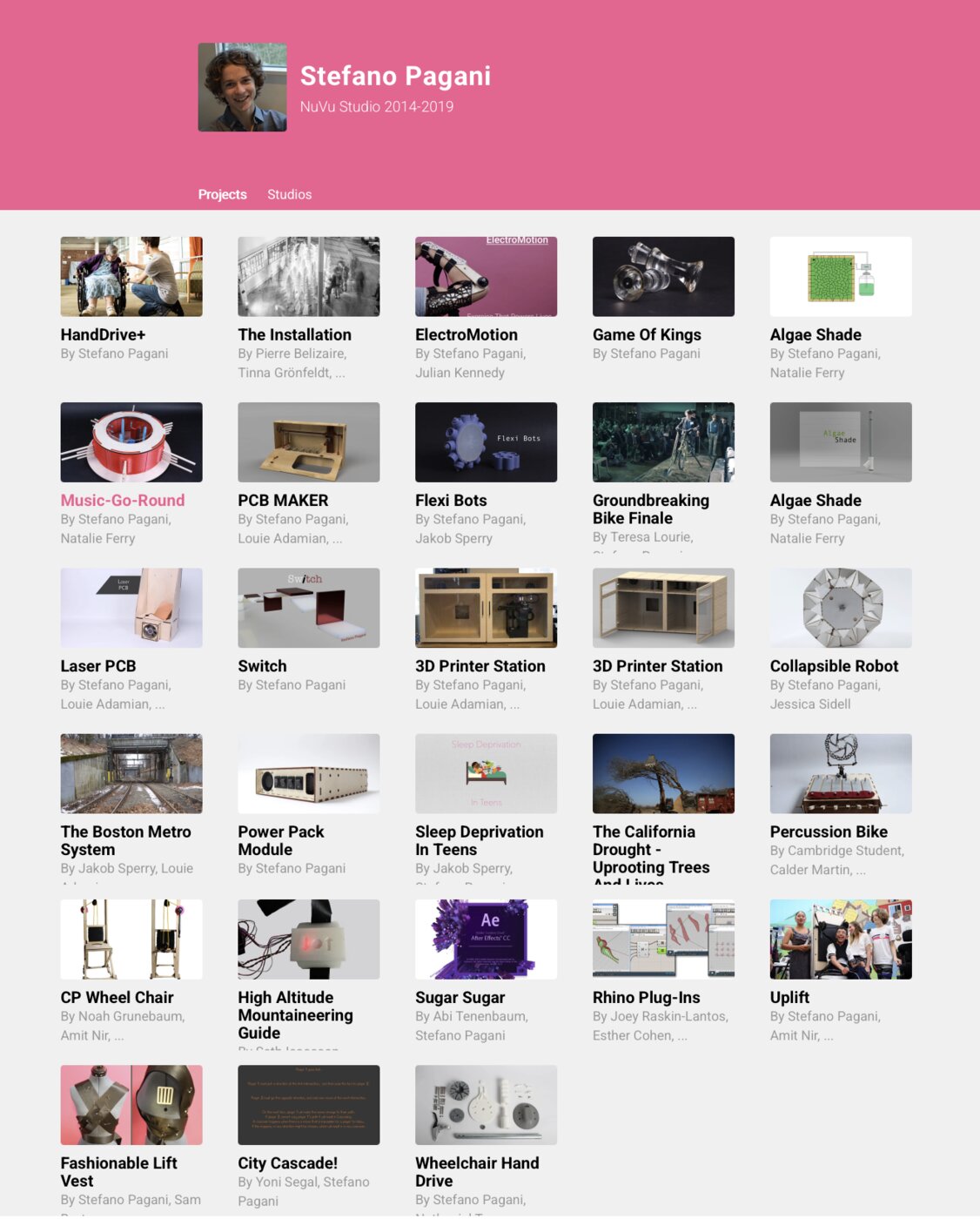
Student portfolio grid showing project work across multiple studios
Student portfolio page — every project documented with process, not just product. Work spanning studios, collaborators, and disciplines in a single view.

Impact: Demonstrated scalability beyond handmade solutions. Maintained a 100% college acceptance rate for graduates. Provided a functional prototype for NuVuX consulting partnerships.

Prototype 3 — Full Integration

Bidirectional feedback, student agency, growth tracking

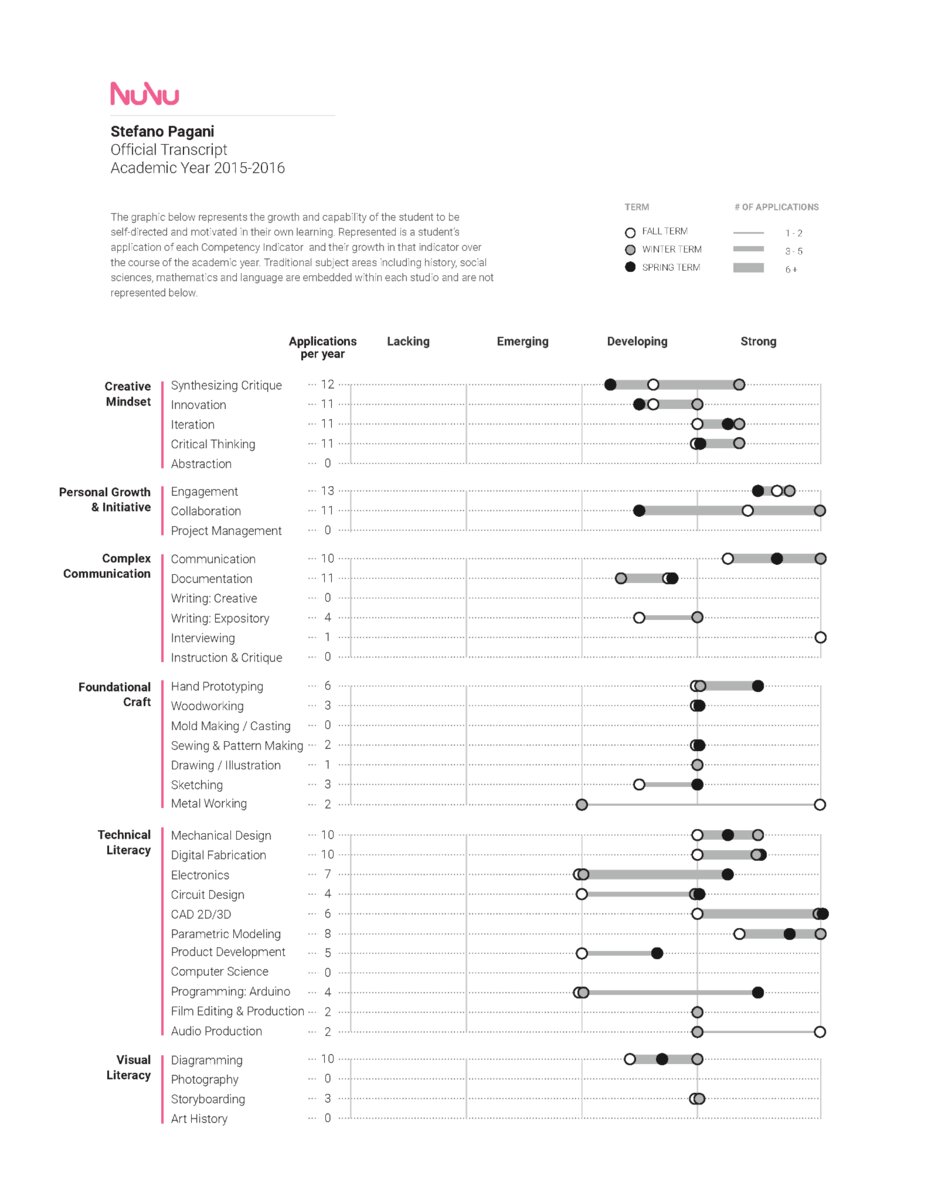
This iteration embedded bidirectional feedback as a core feature of studio practice. Student writing and documentation became central, giving learners full agency in shaping their narratives of growth. Faculty gained deeper development tracking. Shared language and structures began shaping graduation requirements. The transcript and portfolio unified around NuVu's core skills: process, iteration, collaboration, and critique.

Transcript v3 front page
Transcript v3 back page with assessment detail
The transcript as a learning tool — supporting self-awareness, faculty practice, and clearer communication of achievement.
Final Version — Transcript + SMS Ecosystem

From static record to living infrastructure

The transcript evolved from a standalone document into one layer of a comprehensive Studio Management System — a living ecosystem where teaching, learning, and growth were captured in real time. Where a traditional LMS manages logistics, the SMS made NuVu's design process visible and valued: documentation, iteration, critique, and reflection as first-class activities.
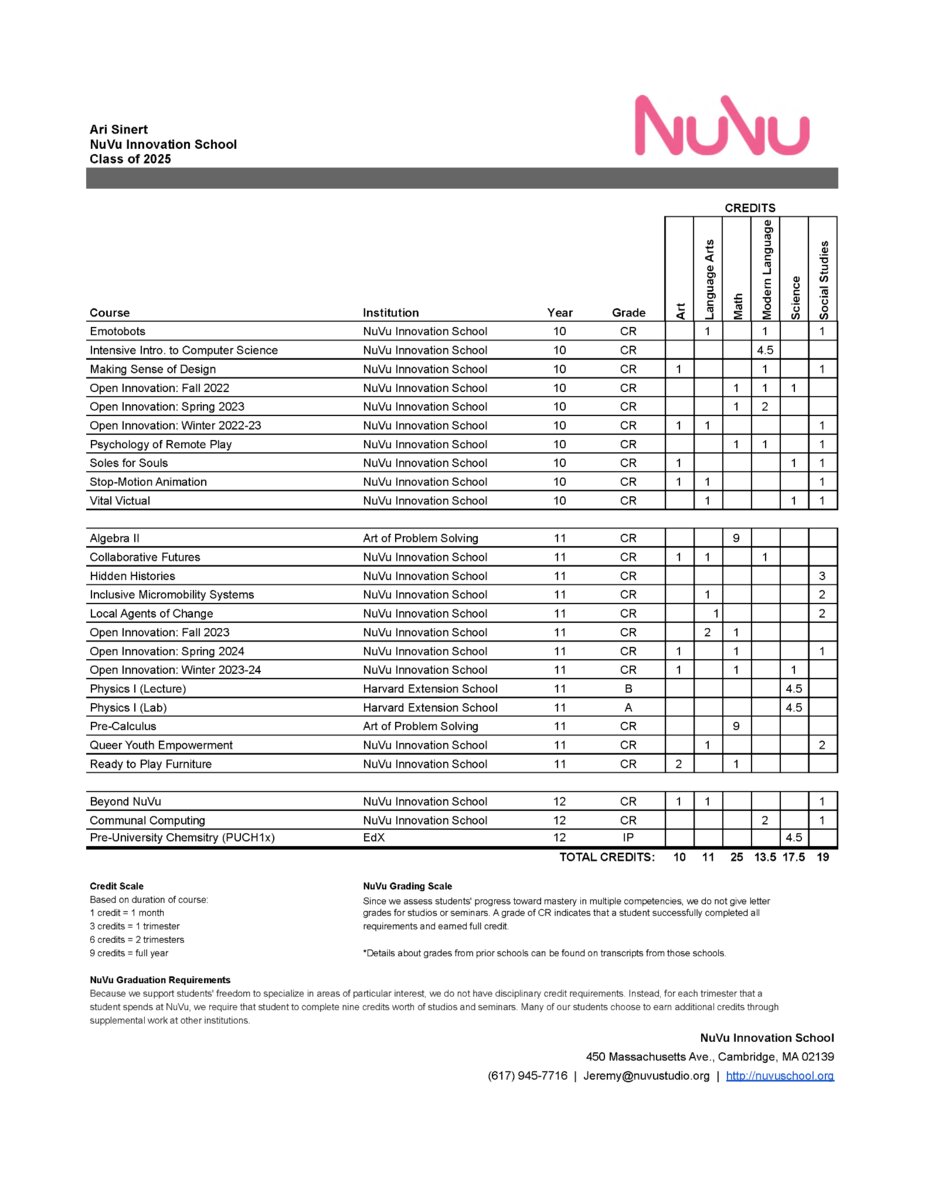
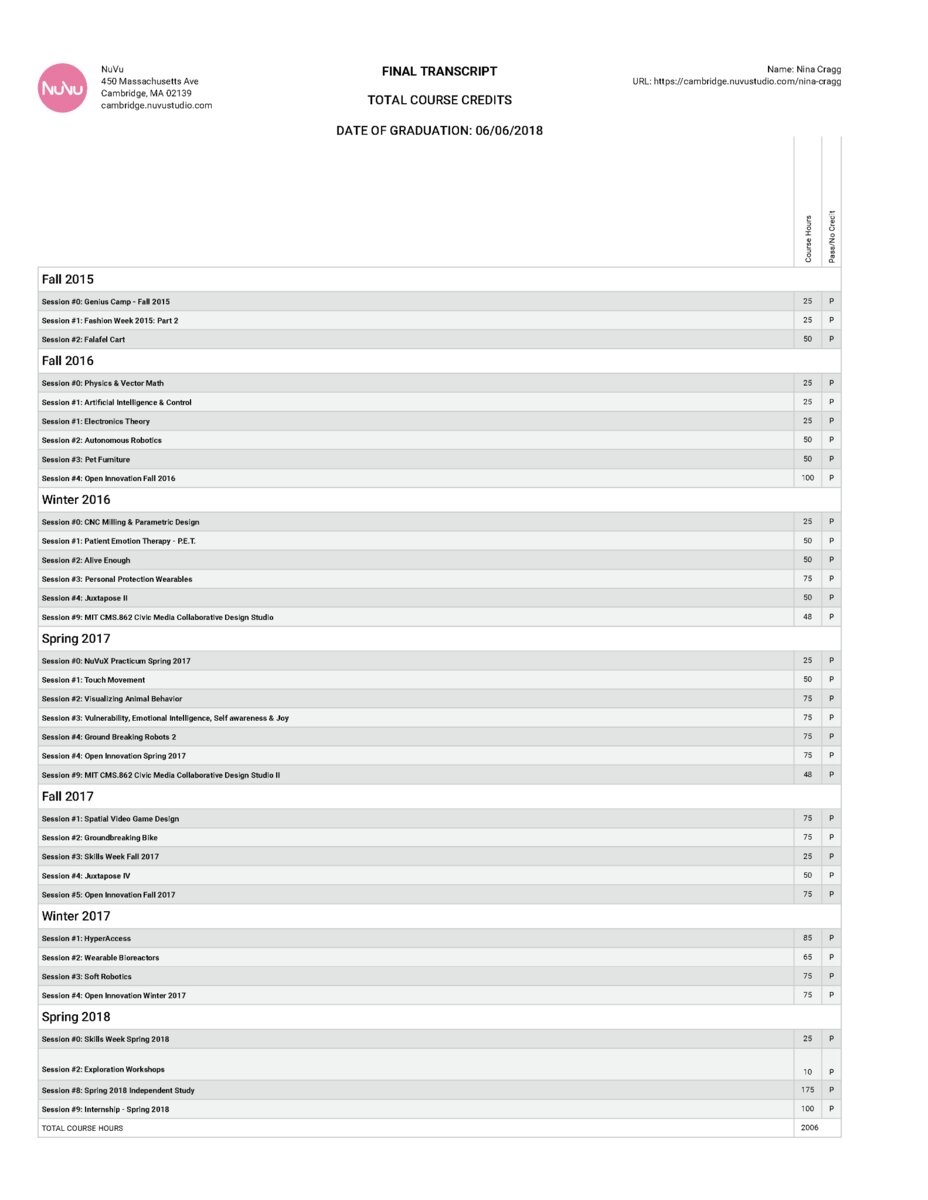
Final transcript document
Final transcript — institutional legibility with the nuance of process-based learning.
Final portfolio view
Portfolio view — documentation, projects, and growth in a navigable record.

Impact: Delivered a scalable, adaptable framework adopted across 7 countries and 7,000+ students. Gave clarity and legitimacy for colleges and employers while preserving the nuance of process-based learning. Positioned NuVu as both a pioneering school and a service provider.
The System

Not an LMS — a Studio Collaboration Platform

Traditional learning management systems are built for content delivery and testing. The SMS was built for something fundamentally different: making creative, iterative, collaborative work visible and evaluable. The distinction isn't branding — it's architectural.

Traditional LMS Studio Management System
Linear, course-driven Iterative + process-based
Supports siloed knowledge acquisition Supports interdisciplinary, project-based learning
Focused on content delivery + testing Embedded reflection, documentation, critique
Assessment = grades + standardized measures Assessment = growth, skills, competencies, feedback loops
Portfolios only for final presentation (if at all) Portfolio = living record of process + outcomes
One-directional (teacher → student) Bi-directional (student ↔ teacher, peers, mentors, community)
Rigid, siloed, detached from pedagogy Adaptable, scalable, fully integrated with pedagogy
Transcript as Record + Reflection
A rigorous format for colleges and employers that simultaneously served as a student self-reflection tool. Assessment was reciprocal — students and faculty both contributed.
Pedagogy-Embedded Platform
Curriculum, portfolio, and assessment unified so NuVu's design process — documentation, iteration, critique, reflection — was structurally embedded, not bolted on.
Peer-to-Peer Visibility
A shared studio space that amplified collaboration, critique, and cross-pollination of ideas. Students could collaborate visually with teammates across the NuVu network and around the globe.
Assessment Architecture

Five competency domains — not grades

The assessment system was organized around five competency domains, each with specific sub-skills. All studios explicitly integrated these Design Skills, which reflect the basic tools for effective ideation, collaboration, design process, self-awareness, documentation, and presentation. Progress was tracked through collaborative goal-setting, visual indicators, and narrative evaluation — not letter grades or standardized measures.

Domain 1
Creative Mindset
Conceptualization Design Research Iteration Critical Synthesis
Domain 2
Personal Growth
Engagement Initiative Collaboration Project Management
Domain 3
Critical Communication
Data Comprehension Applied Reading Critical Writing Oral Presentation
Domain 4
Contextual Framing
Social Contextualization Cultural & Historical Awareness Design Empathy Civic Participation
Domain 5
Making Techniques
Visual Communication Natural Sciences Application Rapid Prototyping Programming or Electronics Advanced Media Fabrication & Construction
Tracking Goals — Not Grades

Each student set individual goals with their advisors, tracked progress through rich discussion and documented evidence, and celebrated achievements before setting new targets. The system made growth visible without reducing it to a number.

EXAMPLE — PROGRESS VISUALIZATION
Creative Mindset
Personal Growth
Critical Communication
Contextual Framing
Making Techniques
EXAMPLE — NARRATIVE GOAL
Goal Set — Fall 2021
She feels like the research she's done so far has been focused mainly on materials and precedents. She'd like to learn to dig deeper so she can feel more confident about the conceptual layer of future projects.
Goal Achieved — Winter 2021-22
While she sometimes felt impatient and eager to jump to physical prototyping, she spent more time focusing on her research. She was proud of the depth, and she found it very helpful to talk with her coach about her sources. She can see how the increased amount of research has given her a stronger foundation for her Capstone project.
Impact

A framework adopted worldwide

7
Countries
7,000+
Students
15
Partner Schools
100%
College Acceptance
6
Years of Iteration
For Students
A mirror of their growth — empowering them with agency, voice, and a language for their learning. Students shared their process with family, colleges, and the world.
For Faculty
Both a feedback loop and a professional development tool. Shared language and assessment structures shaped studio practice as much as they recorded it.
For Partner Schools
A scalable, adaptable framework that enabled schools — especially public schools without robust systems — to track and communicate learning in new ways.
Exhibits
Graduation Stories — First Full-Time Class